In early modern England, print houses called themselves "chapels," and they had some interesting norms around what they called "solaces," as described in Joseph Moxon's 1683 Mechanick exercises, or, The doctrine of handy-works : applied to the art of printing.

Monday, April 27, 2020

Wednesday, April 22, 2020
From Poets v. Crystals (WiP)
Bun was making a list of things to tell his younger self. He would get his chance this afternoon.
He wrote: "Haircuts and shaving."
He wrote: "Haircuts and shaving."
He wrote: "'Jump' older."
He thought about it, and added: "(in 'jumps')."
Bun checked the time weather on his phone. It looked like he would only get one chance.
And added: "Sleeps, food, sick."
Bun scratched his moustache. These words did not yet capture his real point, which was how shaving his face or cutting his hair always made him appear more youthful in the mirror, but youthful by a different and unpredictable increment with every shave and haircut. It was through this invisible steady progress forward and variable 'jumping' back that change revealed itself. He thought this would be useful for his younger self to know, not exactly for itself, but for some vaguer truth toward which it gestured.
Or try a different metaphor. Life considered as a whole, Bun now knew, was like those sicknesses which compose so many of its most vibrant and vital episodes. As you wrestle in your sweats, you do not continually feel yourself worsening and strengthening. Despite all its nowness, the unbearable immanence of illness, still you must always wait for something, for the next big update, as with any news cycle, you must scroll aimless in yourself till your body holds its press conference, till your body comes out to face the cameras at some significant juncture, after a meal, a sip, a dream, a care-giver's visit, the moment you step outdoors, bed time, and change of the temperature.
This advice, which even grown-up Bun struggled to express to himself, would probably not be much fun for young Bun. Yet why not? Why not teach oneself things one doesn't even know oneself? To teach yourself something you already know feels like a waste. The boy had more time to decide what to do with this shimmering and fragmentary understanding. More time to be free of it.
What was 'advice' anyway? A form of something else? Education. Instruction. Seduction. Warning. Care. Or could advice be a thing-in-itself? And if a thing-in-itself, then is advice to be found only in some places, or is it available everywhere, like space and time? Do all things give ample guidance, if only you can bear to read it? A severed head. A game of Chess. Do they emanate advice? Should Bun perhaps say nothing, only smile gently and give himself a slow, solemn nod?
Bun scratched his moustache. These words did not yet capture his real point, which was how shaving his face or cutting his hair always made him appear more youthful in the mirror, but youthful by a different and unpredictable increment with every shave and haircut. It was through this invisible steady progress forward and variable 'jumping' back that change revealed itself. He thought this would be useful for his younger self to know, not exactly for itself, but for some vaguer truth toward which it gestured.
Or try a different metaphor. Life considered as a whole, Bun now knew, was like those sicknesses which compose so many of its most vibrant and vital episodes. As you wrestle in your sweats, you do not continually feel yourself worsening and strengthening. Despite all its nowness, the unbearable immanence of illness, still you must always wait for something, for the next big update, as with any news cycle, you must scroll aimless in yourself till your body holds its press conference, till your body comes out to face the cameras at some significant juncture, after a meal, a sip, a dream, a care-giver's visit, the moment you step outdoors, bed time, and change of the temperature.
This advice, which even grown-up Bun struggled to express to himself, would probably not be much fun for young Bun. Yet why not? Why not teach oneself things one doesn't even know oneself? To teach yourself something you already know feels like a waste. The boy had more time to decide what to do with this shimmering and fragmentary understanding. More time to be free of it.
What was 'advice' anyway? A form of something else? Education. Instruction. Seduction. Warning. Care. Or could advice be a thing-in-itself? And if a thing-in-itself, then is advice to be found only in some places, or is it available everywhere, like space and time? Do all things give ample guidance, if only you can bear to read it? A severed head. A game of Chess. Do they emanate advice? Should Bun perhaps say nothing, only smile gently and give himself a slow, solemn nod?
Bun had a go at the nod.
Bun crossed out "Haircuts and shavings."
Why did advice come in pieces? Pieces of what? Was something being torn apart?
Bun wrote down, "Men so beautiful but beauty up-side-down" and crossed it out immediately, as if the long line of the strike-through were just the final letter of the final word.
Bun crossed out "Haircuts and shavings."
Why did advice come in pieces? Pieces of what? Was something being torn apart?
Bun wrote down, "Men so beautiful but beauty up-side-down" and crossed it out immediately, as if the long line of the strike-through were just the final letter of the final word.
He checked the time weather on his phone.
Later that day -- but also forty years earlier on the beach at Tsutsumigaura -- Bun was feeling a little crestfallen at how the encounter had unfolded. Sensing time's ticklish arms gathering him up to carry him to where he belonged, Bun suddenly remembered the list!
Later that day -- but also forty years earlier on the beach at Tsutsumigaura -- Bun was feeling a little crestfallen at how the encounter had unfolded. Sensing time's ticklish arms gathering him up to carry him to where he belonged, Bun suddenly remembered the list!
Hastily uncrumpling the blurred scratchings and strike-throughs, Bun bellowed across the luminous gusting grey-green sands to his skinny naked seven-year-old self, as he scampered and plunged in the white-capped blue-black billows: "Haircuts and hairballs! Jumps older to jumps! Sleeps and foods and sicks! I'm old you!"
And snapped right back to now.
And snapped right back to now.
Friday, April 10, 2020
The bits with the crown
In The Famous Victories of Henry the Fifth (anonymous):
HENRY 5: Ah Harry, thrice unhappie, that hath neglect so
long from visiting of thy sicke father, I will goe. Nay but why
doo I not go to the Chamber of my sick father, to comfort the
melancholy soule of his bodie: his soule said I, here is his ...
bodie indeed, but his soule is whereas it needs no bodie.
Now thrice accursed Harry, that hath offended thy father so much,
and could not I craue pardon for all. Oh my dying father,
curst be the day wherin I was borne, and accursed be the
houre wherin I was begotten, but what shal I do? if weeping
teares which come too late, may suffice the negligence neglected
too soone, I wil weepe day and night until the
fountaine be drie with weeping. [Exit.]
[Enter Lord of Exeter and Oxford.]
EXETER: Come easily my Lord, for waking of the King.
HENRY 4: Now my Lords.
OXFORD: How doth your Grace feele your selfe?
HENRY 4: Somewhat better after my sleepe,
But good my Lords take off my Crowne,
Remoue my chaire a litle backe, and set me right.
BOTH: And please your grace, the crown is taken away.
HENRY 4: The Crowne taken away,
Good my Lord of Oxford, go see who hath done this deed:
No doubt tis some vilde traitor that hath done it,
To depriue my sonne, they that would do it now,
Would seeke to scrape and scrawle for it after my death.
[Enter Lord of Oxford with the Prince.]
OXFORD: Here and please your Grace ...
Is my Lord the yong Prince with the Crowne.
HENRY 4: Why how now my sonne?
I had thought the last time I had you in schooling,
I had giuen you a lesson for all,
And do you now begin againe?
Why tel me my sonne,
Doest thou thinke the time so long,
that thou wouldest haue it before the
Breath be out of my mouth?
HENRY 5: Most soueraign Lord, and welbeloued father, ...
I came into your Chamber to comfort the melancholy
Soule of your bodie, and finding you at that time
Past all recouerie, and dead to my thinking,
God is my witnesse, and what should I doo,
But with weeping tears lament the death of you my father,
And after that, seeing the Crowne, I tooke it:
And tel me my father, who might better take it then I,
After your death? but seeing you liue,
I most humbly render it into your Maiesties hands,
And the happiest man aliue, that my father liue: ...
And liue my Lord and Father, for euer.
HENRY 4: Stand vp my sonne,
Thine answere hath sounded wel in mine eares,
For I must need confesse that I was in a very sound sleep,
And altogither unmindful of thy comming:
But come neare my sonne,
And let me put thee in possession whilst I liue,
That none depriue thee of it after my death.
HENRY 5: Well may I take it at your maiesties hands,
But it shal neuer touch my head, so long as my father liues. ...
[He taketh the Crowne.]
HENRY 4: God giue thee ioy my sonne,
God blesse thee and make thee his seruant,
And send thee a prosperous raigne,
For God knowes my sonne, how hardly I came by it,
And how hardly I haue maintained it.
In King Henry IV Part 2 (by Shakespeare):
PRINCE. No; I will sit and watch here by the King.
Exeunt all but the PRINCE
Why doth the crown lie there upon his pillow,
Being so troublesome a bedfellow?
O polish'd perturbation! golden care!
That keep'st the ports of slumber open wide
To many a watchful night! Sleep with it now!
Yet not so sound and half so deeply sweet
As he whose brow with homely biggen bound
Snores out the watch of night. O majesty!
When thou dost pinch thy bearer, thou dost sit
Like a rich armour worn in heat of day
That scald'st with safety. By his gates of breath
There lies a downy feather which stirs not.
Did he suspire, that light and weightless down
Perforce must move. My gracious lord! my father!
This sleep is sound indeed; this is a sleep
That from this golden rigol hath divorc'd
So many English kings. Thy due from me
Is tears and heavy sorrows of the blood
Which nature, love, and filial tenderness,
Shall, O dear father, pay thee plenteously.
My due from thee is this imperial crown,
Which, as immediate from thy place and blood,
Derives itself to me. [Putting on the crown] Lo where it
sits --
Which God shall guard; and put the world's whole strength
Into one giant arm, it shall not force
This lineal honour from me. This from thee
Will I to mine leave as 'tis left to me. Exit
KING. Warwick! Gloucester! Clarence!
KING. Why did you leave me here alone, my lords?
CLARENCE. We left the Prince my brother here, my liege,
Who undertook to sit and watch by you.
KING. The Prince of Wales! Where is he? Let me see him.
He is not here.
WARWICK. This door is open; he is gone this way.
PRINCE HUMPHREY. He came not through the chamber where we
stay'd.
KING. Where is the crown? Who took it from my pillow?
WARWICK. When we withdrew, my liege, we left it here.
KING. The Prince hath ta'en it hence. Go, seek him out.
Is he so hasty that he doth suppose
My sleep my death?
Find him, my lord of Warwick; chide him hither.
Exit WARWICK
This part of his conjoins with my disease
WARWICK. My lord, I found the Prince in the next room,
Washing with kindly tears his gentle cheeks,
With such a deep demeanour in great sorrow,
That tyranny, which never quaff'd but blood,
Would, by beholding him, have wash'd his knife
With gentle eye-drops. He is coming hither.
KING. But wherefore did he take away the crown?
PRINCE. I never thought to hear you speak again.
KING. Thy wish was father, Harry, to that thought.
I stay too long by thee, I weary thee.
Dost thou so hunger for mine empty chair
That thou wilt needs invest thee with my honours
Before thy hour be ripe? O foolish youth!
Thou seek'st the greatness that will overwhelm thee.
Stay but a little, for my cloud of dignity
Is held from falling with so weak a wind
That it will quickly drop; my day is dim.
Thou hast stol'n that which, after some few hours,
Were thine without offense; and at my death
Thou hast seal'd up my expectation.
Thy life did manifest thou lov'dst me not,
And thou wilt have me die assur'd of it.
Thou hid'st a thousand daggers in thy thoughts,
Which thou hast whetted on thy stony heart,
To stab at half an hour of my life.
What, canst thou not forbear me half an hour?
Then get thee gone, and dig my grave thyself;
And bid the merry bells ring to thine ear
That thou art crowned, not that I am dead.
Let all the tears that should bedew my hearse
Be drops of balm to sanctify thy head;
Only compound me with forgotten dust;
Give that which gave thee life unto the worms.
Pluck down my officers, break my decrees;
For now a time is come to mock at form --
Harry the Fifth is crown'd. Up, vanity:
Down, royal state. All you sage counsellors, hence.
And to the English court assemble now,
From every region, apes of idleness.
Now, neighbour confines, purge you of your scum.
Have you a ruffian that will swear, drink, dance,
Revel the night, rob, murder, and commit
The oldest sins the newest kind of ways?
Be happy, he will trouble you no more.
England shall double gild his treble guilt;
England shall give him office, honour, might;
For the fifth Harry from curb'd license plucks
The muzzle of restraint, and the wild dog
Shall flesh his tooth on every innocent.
O my poor kingdom, sick with civil blows!
When that my care could not withhold thy riots,
What wilt thou do when riot is thy care?
O, thou wilt be a wilderness again.
Peopled with wolves, thy old inhabitants!
PRINCE. O, pardon me, my liege! But for my tears,
The moist impediments unto my speech,
I had forestall'd this dear and deep rebuke
Ere you with grief had spoke and I had heard
The course of it so far. There is your crown,
And he that wears the crown immortally
Long guard it yours! [Kneeling] If I affect it more
Than as your honour and as your renown,
Let me no more from this obedience rise,
Which my most inward true and duteous spirit
Teacheth this prostrate and exterior bending!
God witness with me, when I here came in
And found no course of breath within your Majesty,
How cold it struck my heart! If I do feign,
O, let me in my present wildness die,
And never live to show th' incredulous world
The noble change that I have purposed!
Coming to look on you, thinking you dead—
And dead almost, my liege, to think you were—
I spake unto this crown as having sense,
And thus upbraided it: 'The care on thee depending
Hath fed upon the body of my father;
Therefore thou best of gold art worst of gold.
Other, less fine in carat, is more precious,
Preserving life in med'cine potable;
But thou, most fine, most honour'd, most renown'd,
Hast eat thy bearer up.' Thus, my most royal liege,
Accusing it, I put it on my head,
To try with it—as with an enemy
That had before my face murd'red my father—
The quarrel of a true inheritor.
But if it did infect my blood with joy,
Or swell my thoughts to any strain of pride;
If any rebel or vain spirit of mine
Did with the least affection of a welcome
Give entertainment to the might of it,
Let God for ever keep it from my head,
And make me as the poorest vassal is,
That doth with awe and terror kneel to it!
KING. O my son,
God put it in thy mind to take it hence,
That thou mightst win the more thy father's love,
Pleading so wisely in excuse of it!
Come hither, Harry; sit thou by my bed,
And hear, I think, the very latest counsel
That ever I shall breathe. God knows, my son,
By what by-paths and indirect crook'd ways
I met this crown; and I myself know well
How troublesome it sat upon my head:
To thee it shall descend with better quiet,
Better opinion, better confirmation;
For all the soil of the achievement goes
With me into the earth. It seem'd in me
But as an honour snatch'd with boist'rous hand;
And I had many living to upbraid
My gain of it by their assistances;
Which daily grew to quarrel and to bloodshed,
Wounding supposed peace. All these bold fears
Thou seest with peril I have answered;
For all my reign hath been but as a scene
Acting that argument. And now my death
Changes the mood; for what in me was purchas'd
Falls upon thee in a more fairer sort;
So thou the garland wear'st successively.
Yet, though thou stand'st more sure than I could do,
Thou art not firm enough, since griefs are green;
And all my friends, which thou must make thy friends,
Have but their stings and teeth newly ta'en out;
By whose fell working I was first advanc'd,
And by whose power I well might lodge a fear
To be again displac'd; which to avoid,
I cut them off; and had a purpose now
To lead out many to the Holy Land,
Lest rest and lying still might make them look
Too near unto my state. Therefore, my Harry,
Be it thy course to busy giddy minds
With foreign quarrels, that action, hence borne out,
May waste the memory of the former days.
More would I, but my lungs are wasted so
That strength of speech is utterly denied me.
How I came by the crown, O God, forgive;
And grant it may with thee in true peace live!
PRINCE. My gracious liege,
You won it, wore it, kept it, gave it me;
Then plain and right must my possession be;
Which I with more than with a common pain
'Gainst all the world will rightfully maintain.
There's actually a three-way comparison available here, if we also include Hal's speech over the sleeping King, compared with how he recounts the incident later. Without necessarily doubting the sincerity of Hal's general gist (he loves his dad, he doesn't want him to die, he's going to mend his ways etc. etc.), we can clearly tell that his recollection embellishes, conceals, and transforms. Hal is not performing his socks off in hope of a moment of cognitive and affective sharing. He's doing something he learned from the best, from Sir John Falstaff: he's coming up with a cover story. The length of the King's lament -- and the kinds of excuses it implicitly pre-empts -- gives the actor playing Hal plenty of tense silence in which to be furiously devising.
(In a similar vein, Falstaff's companions seem to delight in nudging Falstaff into tight corners: Let's see him talk his way out of THIS one. The otherwise ponderous objections his companions tend to raise to Falstaff's excuses confirm this is what's going on: they like to play it straight, and push Falstaff to extremes of brazen and nimble wit).
In view of the theme of debt and indebtedness that runs so prominently throughout Part One and is still doing interesting things in Part Two, it is interesting that what Hal elides is who owes what to whom:
[...] My gracious lord! my father!
This sleep is sound indeed; this is a sleep
That from this golden rigol hath divorc'd
So many English kings. Thy due from me
Is tears and heavy sorrows of the blood
Which nature, love, and filial tenderness,
Shall, O dear father, pay thee plenteously.
HENRY 5: Ah Harry, thrice unhappie, that hath neglect so
long from visiting of thy sicke father, I will goe. Nay but why
doo I not go to the Chamber of my sick father, to comfort the
melancholy soule of his bodie: his soule said I, here is his ...
bodie indeed, but his soule is whereas it needs no bodie.
Now thrice accursed Harry, that hath offended thy father so much,
and could not I craue pardon for all. Oh my dying father,
curst be the day wherin I was borne, and accursed be the
houre wherin I was begotten, but what shal I do? if weeping
teares which come too late, may suffice the negligence neglected
too soone, I wil weepe day and night until the
fountaine be drie with weeping. [Exit.]
[Enter Lord of Exeter and Oxford.]
EXETER: Come easily my Lord, for waking of the King.
HENRY 4: Now my Lords.
OXFORD: How doth your Grace feele your selfe?
HENRY 4: Somewhat better after my sleepe,
But good my Lords take off my Crowne,
Remoue my chaire a litle backe, and set me right.
BOTH: And please your grace, the crown is taken away.
HENRY 4: The Crowne taken away,
Good my Lord of Oxford, go see who hath done this deed:
No doubt tis some vilde traitor that hath done it,
To depriue my sonne, they that would do it now,
Would seeke to scrape and scrawle for it after my death.
[Enter Lord of Oxford with the Prince.]
OXFORD: Here and please your Grace ...
Is my Lord the yong Prince with the Crowne.
HENRY 4: Why how now my sonne?
I had thought the last time I had you in schooling,
I had giuen you a lesson for all,
And do you now begin againe?
Why tel me my sonne,
Doest thou thinke the time so long,
that thou wouldest haue it before the
Breath be out of my mouth?
HENRY 5: Most soueraign Lord, and welbeloued father, ...
I came into your Chamber to comfort the melancholy
Soule of your bodie, and finding you at that time
Past all recouerie, and dead to my thinking,
God is my witnesse, and what should I doo,
But with weeping tears lament the death of you my father,
And after that, seeing the Crowne, I tooke it:
And tel me my father, who might better take it then I,
After your death? but seeing you liue,
I most humbly render it into your Maiesties hands,
And the happiest man aliue, that my father liue: ...
And liue my Lord and Father, for euer.
HENRY 4: Stand vp my sonne,
Thine answere hath sounded wel in mine eares,
For I must need confesse that I was in a very sound sleep,
And altogither unmindful of thy comming:
But come neare my sonne,
And let me put thee in possession whilst I liue,
That none depriue thee of it after my death.
HENRY 5: Well may I take it at your maiesties hands,
But it shal neuer touch my head, so long as my father liues. ...
[He taketh the Crowne.]
HENRY 4: God giue thee ioy my sonne,
God blesse thee and make thee his seruant,
And send thee a prosperous raigne,
For God knowes my sonne, how hardly I came by it,
And how hardly I haue maintained it.
In King Henry IV Part 2 (by Shakespeare):
WARWICK. Will't please your Grace to go along with us?
PRINCE. No; I will sit and watch here by the King.
Exeunt all but the PRINCE
Why doth the crown lie there upon his pillow,
Being so troublesome a bedfellow?
O polish'd perturbation! golden care!
That keep'st the ports of slumber open wide
To many a watchful night! Sleep with it now!
Yet not so sound and half so deeply sweet
As he whose brow with homely biggen bound
Snores out the watch of night. O majesty!
When thou dost pinch thy bearer, thou dost sit
Like a rich armour worn in heat of day
That scald'st with safety. By his gates of breath
There lies a downy feather which stirs not.
Did he suspire, that light and weightless down
Perforce must move. My gracious lord! my father!
This sleep is sound indeed; this is a sleep
That from this golden rigol hath divorc'd
So many English kings. Thy due from me
Is tears and heavy sorrows of the blood
Which nature, love, and filial tenderness,
Shall, O dear father, pay thee plenteously.
My due from thee is this imperial crown,
Which, as immediate from thy place and blood,
Derives itself to me. [Putting on the crown] Lo where it
sits --
Which God shall guard; and put the world's whole strength
Into one giant arm, it shall not force
This lineal honour from me. This from thee
Will I to mine leave as 'tis left to me. Exit
KING. Warwick! Gloucester! Clarence!
Re-enter WARWICK, GLOUCESTER, CLARENCE
CLARENCE. Doth the King call?
WARWICK. What would your Majesty? How fares your Grace?
KING. Why did you leave me here alone, my lords?
CLARENCE. We left the Prince my brother here, my liege,
Who undertook to sit and watch by you.
KING. The Prince of Wales! Where is he? Let me see him.
He is not here.
WARWICK. This door is open; he is gone this way.
PRINCE HUMPHREY. He came not through the chamber where we
stay'd.
KING. Where is the crown? Who took it from my pillow?
WARWICK. When we withdrew, my liege, we left it here.
KING. The Prince hath ta'en it hence. Go, seek him out.
Is he so hasty that he doth suppose
My sleep my death?
Find him, my lord of Warwick; chide him hither.
Exit WARWICK
This part of his conjoins with my disease
And helps to end me. See, sons, what things you are!
How quickly nature falls into revolt
When gold becomes her object!
For this the foolish over-careful fathers
Have broke their sleep with thoughts,
Their brains with care, their bones with industry;
For this they have engrossed and pil'd up
The cank'red heaps of strange-achieved gold;
For this they have been thoughtful to invest
Their sons with arts and martial exercises;
When, like the bee, tolling from every flower
The virtuous sweets,
Our thighs with wax, our mouths with honey pack'd,
We bring it to the hive, and, like the bees,
Are murd'red for our pains. This bitter taste
Yields his engrossments to the ending father.
How quickly nature falls into revolt
When gold becomes her object!
For this the foolish over-careful fathers
Have broke their sleep with thoughts,
Their brains with care, their bones with industry;
For this they have engrossed and pil'd up
The cank'red heaps of strange-achieved gold;
For this they have been thoughtful to invest
Their sons with arts and martial exercises;
When, like the bee, tolling from every flower
The virtuous sweets,
Our thighs with wax, our mouths with honey pack'd,
We bring it to the hive, and, like the bees,
Are murd'red for our pains. This bitter taste
Yields his engrossments to the ending father.
Re-enter WARWICK
Now where is he that will not stay so long
Till his friend sickness hath determin'd me?
Till his friend sickness hath determin'd me?
WARWICK. My lord, I found the Prince in the next room,
Washing with kindly tears his gentle cheeks,
With such a deep demeanour in great sorrow,
That tyranny, which never quaff'd but blood,
Would, by beholding him, have wash'd his knife
With gentle eye-drops. He is coming hither.
KING. But wherefore did he take away the crown?
Re-enter PRINCE HENRY
Lo where he comes. Come hither to me, Harry.
Depart the chamber, leave us here alone.
Exeunt all but the KING and the PRINCE
Depart the chamber, leave us here alone.
Exeunt all but the KING and the PRINCE
PRINCE. I never thought to hear you speak again.
KING. Thy wish was father, Harry, to that thought.
I stay too long by thee, I weary thee.
Dost thou so hunger for mine empty chair
That thou wilt needs invest thee with my honours
Before thy hour be ripe? O foolish youth!
Thou seek'st the greatness that will overwhelm thee.
Stay but a little, for my cloud of dignity
Is held from falling with so weak a wind
That it will quickly drop; my day is dim.
Thou hast stol'n that which, after some few hours,
Were thine without offense; and at my death
Thou hast seal'd up my expectation.
Thy life did manifest thou lov'dst me not,
And thou wilt have me die assur'd of it.
Thou hid'st a thousand daggers in thy thoughts,
Which thou hast whetted on thy stony heart,
To stab at half an hour of my life.
What, canst thou not forbear me half an hour?
Then get thee gone, and dig my grave thyself;
And bid the merry bells ring to thine ear
That thou art crowned, not that I am dead.
Let all the tears that should bedew my hearse
Be drops of balm to sanctify thy head;
Only compound me with forgotten dust;
Give that which gave thee life unto the worms.
Pluck down my officers, break my decrees;
For now a time is come to mock at form --
Harry the Fifth is crown'd. Up, vanity:
Down, royal state. All you sage counsellors, hence.
And to the English court assemble now,
From every region, apes of idleness.
Now, neighbour confines, purge you of your scum.
Have you a ruffian that will swear, drink, dance,
Revel the night, rob, murder, and commit
The oldest sins the newest kind of ways?
Be happy, he will trouble you no more.
England shall double gild his treble guilt;
England shall give him office, honour, might;
For the fifth Harry from curb'd license plucks
The muzzle of restraint, and the wild dog
Shall flesh his tooth on every innocent.
O my poor kingdom, sick with civil blows!
When that my care could not withhold thy riots,
What wilt thou do when riot is thy care?
O, thou wilt be a wilderness again.
Peopled with wolves, thy old inhabitants!
PRINCE. O, pardon me, my liege! But for my tears,
The moist impediments unto my speech,
I had forestall'd this dear and deep rebuke
Ere you with grief had spoke and I had heard
The course of it so far. There is your crown,
And he that wears the crown immortally
Long guard it yours! [Kneeling] If I affect it more
Than as your honour and as your renown,
Let me no more from this obedience rise,
Which my most inward true and duteous spirit
Teacheth this prostrate and exterior bending!
God witness with me, when I here came in
And found no course of breath within your Majesty,
How cold it struck my heart! If I do feign,
O, let me in my present wildness die,
And never live to show th' incredulous world
The noble change that I have purposed!
Coming to look on you, thinking you dead—
And dead almost, my liege, to think you were—
I spake unto this crown as having sense,
And thus upbraided it: 'The care on thee depending
Hath fed upon the body of my father;
Therefore thou best of gold art worst of gold.
Other, less fine in carat, is more precious,
Preserving life in med'cine potable;
But thou, most fine, most honour'd, most renown'd,
Hast eat thy bearer up.' Thus, my most royal liege,
Accusing it, I put it on my head,
To try with it—as with an enemy
That had before my face murd'red my father—
The quarrel of a true inheritor.
But if it did infect my blood with joy,
Or swell my thoughts to any strain of pride;
If any rebel or vain spirit of mine
Did with the least affection of a welcome
Give entertainment to the might of it,
Let God for ever keep it from my head,
And make me as the poorest vassal is,
That doth with awe and terror kneel to it!
KING. O my son,
God put it in thy mind to take it hence,
That thou mightst win the more thy father's love,
Pleading so wisely in excuse of it!
Come hither, Harry; sit thou by my bed,
And hear, I think, the very latest counsel
That ever I shall breathe. God knows, my son,
By what by-paths and indirect crook'd ways
I met this crown; and I myself know well
How troublesome it sat upon my head:
To thee it shall descend with better quiet,
Better opinion, better confirmation;
For all the soil of the achievement goes
With me into the earth. It seem'd in me
But as an honour snatch'd with boist'rous hand;
And I had many living to upbraid
My gain of it by their assistances;
Which daily grew to quarrel and to bloodshed,
Wounding supposed peace. All these bold fears
Thou seest with peril I have answered;
For all my reign hath been but as a scene
Acting that argument. And now my death
Changes the mood; for what in me was purchas'd
Falls upon thee in a more fairer sort;
So thou the garland wear'st successively.
Yet, though thou stand'st more sure than I could do,
Thou art not firm enough, since griefs are green;
And all my friends, which thou must make thy friends,
Have but their stings and teeth newly ta'en out;
By whose fell working I was first advanc'd,
And by whose power I well might lodge a fear
To be again displac'd; which to avoid,
I cut them off; and had a purpose now
To lead out many to the Holy Land,
Lest rest and lying still might make them look
Too near unto my state. Therefore, my Harry,
Be it thy course to busy giddy minds
With foreign quarrels, that action, hence borne out,
May waste the memory of the former days.
More would I, but my lungs are wasted so
That strength of speech is utterly denied me.
How I came by the crown, O God, forgive;
And grant it may with thee in true peace live!
PRINCE. My gracious liege,
You won it, wore it, kept it, gave it me;
Then plain and right must my possession be;
Which I with more than with a common pain
'Gainst all the world will rightfully maintain.
There's actually a three-way comparison available here, if we also include Hal's speech over the sleeping King, compared with how he recounts the incident later. Without necessarily doubting the sincerity of Hal's general gist (he loves his dad, he doesn't want him to die, he's going to mend his ways etc. etc.), we can clearly tell that his recollection embellishes, conceals, and transforms. Hal is not performing his socks off in hope of a moment of cognitive and affective sharing. He's doing something he learned from the best, from Sir John Falstaff: he's coming up with a cover story. The length of the King's lament -- and the kinds of excuses it implicitly pre-empts -- gives the actor playing Hal plenty of tense silence in which to be furiously devising.
(In a similar vein, Falstaff's companions seem to delight in nudging Falstaff into tight corners: Let's see him talk his way out of THIS one. The otherwise ponderous objections his companions tend to raise to Falstaff's excuses confirm this is what's going on: they like to play it straight, and push Falstaff to extremes of brazen and nimble wit).
In view of the theme of debt and indebtedness that runs so prominently throughout Part One and is still doing interesting things in Part Two, it is interesting that what Hal elides is who owes what to whom:
[...] My gracious lord! my father!
This sleep is sound indeed; this is a sleep
That from this golden rigol hath divorc'd
So many English kings. Thy due from me
Is tears and heavy sorrows of the blood
Which nature, love, and filial tenderness,
Shall, O dear father, pay thee plenteously.
Tuesday, March 24, 2020
TO THE SURVIVORS
After Brecht's An Die Nachgeborenen.
Undeniably I live in dark days.
Any word without guile is absurd. A soft brow means
a hard heart. Anyone laughing just
hasn't heard
the new news.
And the latest, it's even
a sin to mention a tree,
since it's like this silence
about all this evil.
And whoever walks calmly across the street
retreats out of reach of their friends
who need them now.
Okay true I make a living.
Trust me that's pure fluke. Nothing
I do entitles me to eat.
The fact that I'm okay is a kind of coincidence so the first day my luck fails
I'm lost as well.
They're out here telling me: eat, drink, be thankful for what you have.
Sorry how exactly, when what I eat
is stolen from the sick
and what my water bottle pours belongs in a thirsty person's throat.
Obviously I eat and drink.
I would gladly be wise.
We've all read good advice:
accept what you cannot change, live out your little life,
be fearless,
feel tenderness instead of violence,
turn the other cheek --
don't get disfigured by your desires.
Discover how to transfigure and forget.
I can't do that shit.
I live in dark days.
Any word without guile is absurd. A soft brow means
a hard heart. Anyone laughing just
hasn't heard
the new news.
And the latest, it's even
a sin to mention a tree,
since it's like this silence
about all this evil.
And whoever walks calmly across the street
retreats out of reach of their friends
who need them now.
Okay true I make a living.
Trust me that's pure fluke. Nothing
I do entitles me to eat.
The fact that I'm okay is a kind of coincidence so the first day my luck fails
I'm lost as well.
They're out here telling me: eat, drink, be thankful for what you have.
Sorry how exactly, when what I eat
is stolen from the sick
and what my water bottle pours belongs in a thirsty person's throat.
Obviously I eat and drink.
I would gladly be wise.
We've all read good advice:
accept what you cannot change, live out your little life,
be fearless,
feel tenderness instead of violence,
turn the other cheek --
don't get disfigured by your desires.
Discover how to transfigure and forget.
I can't do that shit.
I live in dark days.
Friday, March 6, 2020
Top Ten Plagues
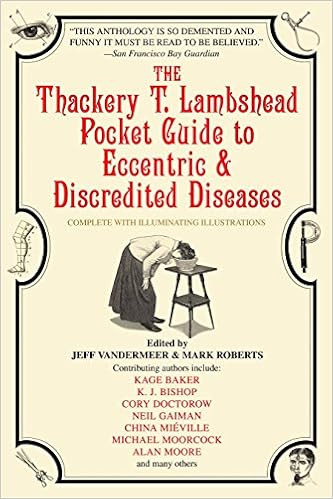
A day or so later, the outer layer of the epidermis splits at the temple into a series of lotus-like petals, apparently causing the victim to force his/her head into the nearest narrow gap (such as a window frame) rather in the manner of a snake attempting to aid the shedding of its skin. Rejecting all offers of help and attempts at restraint, the victim bloodlessly sloughs the skin, 'scrolling it down the torso and limbs in the manner of a tantalizingly unrolled silk stocking' (Mudthumper, p.1168).OK, this one's not really contagious (as far as I know), so it only manages to scraape its way onto the top ten. But it can also be considered a calling card for Thackery's, which is a good source of plagues generally.
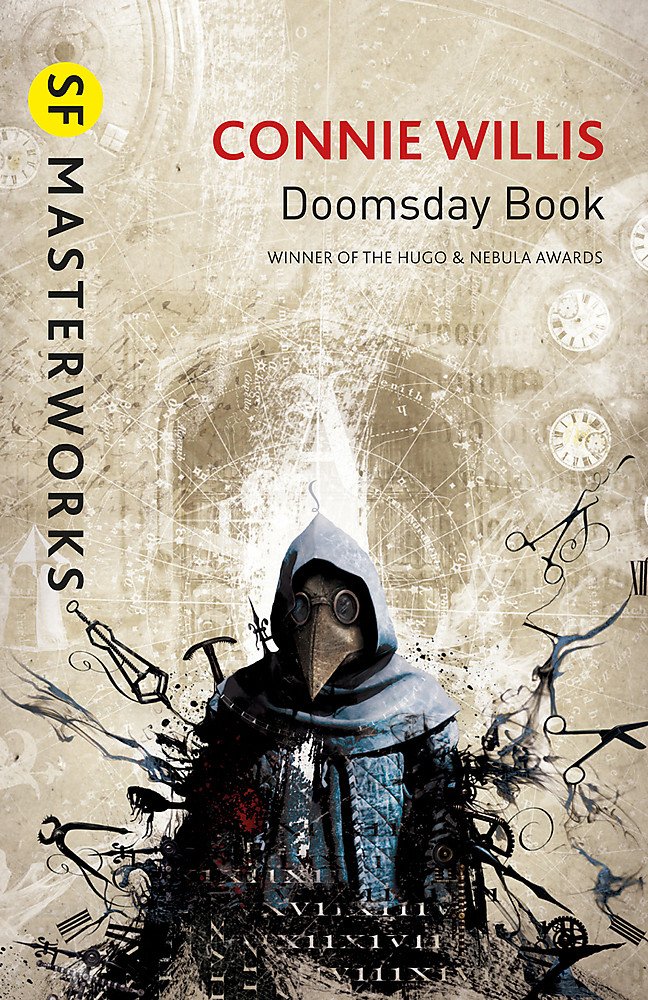
9) Black Death AND Influenza in Connie Willis's time travel tale The Doomsday Book. The time travel conceit allows Willis to compare social responses to epidemic centuries apart. A time traveller, washed up in a part of the past she never intended to visit, tries to summon up some advantage from her superior scientific understanding of events ...
She had tried to remember what remedies the contemps had tried while he was gone. They had carried nosegays of flowers and drunk powdered emeralds and applied leeches to the buboes, but all of those were worse than useless, and Dr Ahrens had said it wouldn't have mattered what they had tried, that nothing except antimicrobials like tetracycline and streptomycin would have worked, and those had not been discovered until the twentieth century.

8) The plague in Daniel Defoe's 1722 Journal of the Plague Year, a hugely formative work in the history of the Western novel.
Thomas. You will go away. Whither will you go, and what can you do? I would as willingly go away as you, if I knew whither. But we have no acquaintance, no friends. Here we were born, and here we must die.
John. Look you, Tom, the whole kingdom is my native country as well as this town. You may as well say I must not go out of my house if it is on fire as that I must not go out of the town I was born in when it is infected with the plague. I was born in England, and have a right to live in it if I can.
Thomas. But you know every vagrant person may by the laws of England be taken up, and passed back to their last legal settlement.
John. But how shall they make me vagrant? I desire only to travel on, upon my lawful occasions.
Thomas. What lawful occasions can we pretend to travel, or rather wander upon? They will not be put off with words.
John. Is not flying to save our lives a lawful occasion?
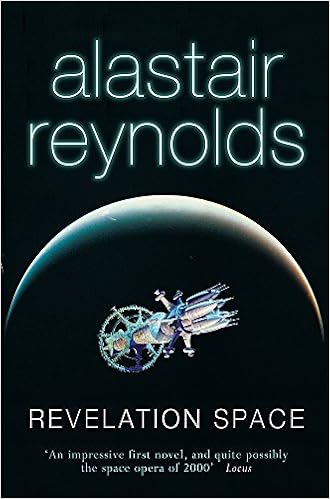
7) The Melding Plague in Alaistar Reynold's Revelation Space books. In a future where most folk are filled with cybernetic implants, this phenomenon fills those implants with a will to expand and go haywire. It tries to synthesise flesh and machine, and it affects both our bodies and our built environment. It's described as almost "purposeful" and almost "artistic."
The servitors lurched forwards, approaching the shattered angel of the Captain. More than ever he looked like something which had not so much crept with glacial slowness from his reefer, but had burst with volcanic ferocity, only to be frozen in a strobe flash. He radiated in every direction parallel to the wall, extending far into the corridor on either side, for dozens of metres. Nearest to him, his grawth consisted of trunk-thick cylinders, the colour of quicksilver, but with the texture of jewel-encrusted slurry, constantly shimmering and twinkling, hinting at phenomenally industrious buried activity. Further away, on his periphery, the branches subdivided into a bronchial-like mesh. At its very boundary, the mesh grew microscopically fine and blended seamlessly with the fabric of its substrate: the ship itself. It was glorious with diffraction patterns, like a membrane of oil on water.HegSwarms in Iain M. Banks's Culture books, are more an example of grey goo, "self-replicating nanotech out of control" trope: a plague propagating through all kinds of physical systems, and not just biological ones. From Surface Detail:
Restoria was the part of Contact charged with taking care of hegemonising swarm outbreaks, when -- by accident or design -- a set of self-replicating entities ran out of control somewhere and started trying to turn the totality of the galaxy's matter into nothing but copies of themselves. It was a problem as old as life in the galaxy and arguably hegswarms were just that; another legitimate -- if rather over-enthusiastic -- galatic life-form type. [...] Even the most urbanely sophisticated, scrupulously empathic and excruciatingly polite civilisation, it had been suggested, was just a hegswarm with a sense of proportion.Reynolds' Melding Plague is grey-goo-adjacent. It stands representative of those speculative sicknesses that are all about highly aestheticised kaleidescopic body horror: not grey goo so much as varicolored-crystalline-n-dimensional-irridescent-goo. There is a sense of a complex patterning logic for which we are the unfortunate substrate. See also Peter F. Hamilton's Zanth, Jeff VanderMeer's Area X (and Alex Garland et al.'s Annihilation adaptation). Compare Reynold's more grey goo-ish Greenfly Terraformers. Hegemonising goos and singularities of various kinds appear in fiction by Charles Stross, Greg Bear, Greg Egan, Rudy Rucker, Linda Nagata, and others.
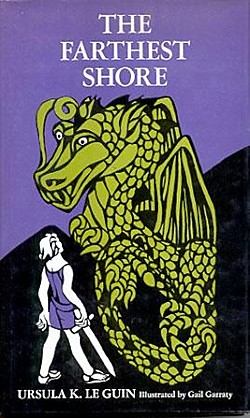
6) The "bad luck," as Sparrowhawk calls it at one point: the mysterious disenchantment in Ursula K. Le Guin's The Farthest Shore. Once more not strictly a plague, though it reproduces some of its logic. There is also a Patient Zero of sorts. See also e.g. Larry Niven's The Magic Goes Away, the Nothing in Michael Ende's The Neverending Story, the Forge in Robin Hobb's Assassin's Apprentice, etc. Within fantasy fiction, sometimes the source of the contagion is something a bit more like a hellmouth. These myriad magical contagions can sometimes be read as oblique commentaries on depression, despair, loneliness, paranoia, and other forms of psychic ill-being, and on capitalism's entwined processes of atomisation, rationalisation, secularisation, and alienation.
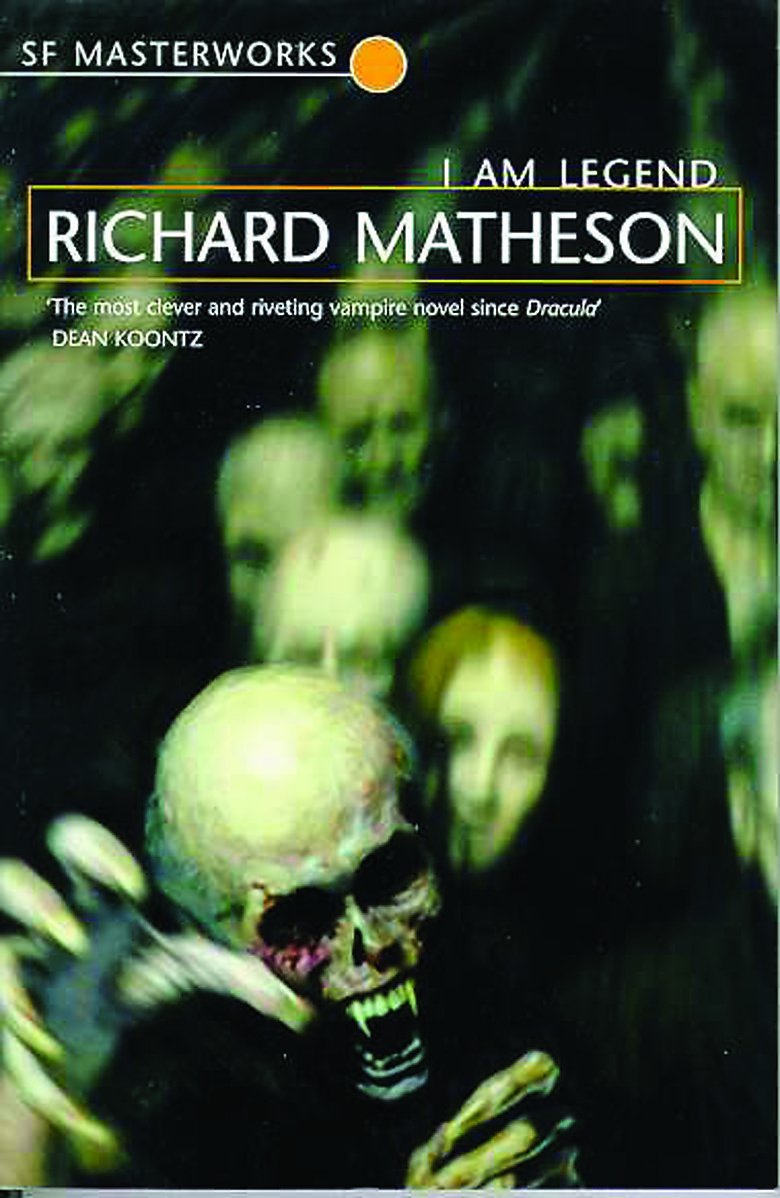
5) The bacillus in Richard Matheson's I Am Legend (1954), which turns everyone into zombie-like vampires. A big influence on the filmmaker Romero and many a zombie story since. See also e.g. the Rage virus in 28 Days Later, the virus in Max Brooks's World War Z, the cordyceps infection in the Last of Us games, and the viruses in Mira Grant's Newsflesh books. But virus or no virus, these kinds of apocalyptic zombie narratives are almost always closely associated with pandemics. Whether your zombies are fast or slow, eldritch or techno-scientific, whether they are partial to brains or just mad as hell, it's the extreme contagiousness of the condition that is at the heart of this myth, and that differentiates the apocalyptic zombie from the "sorcerer's undead servant" style zombie. Spreading is the apocalyptic zombie's MO. Consider that vampirism and lycanthropy are also often supposed to be transmitted by a bite, yet vampires and werewolves -- Matheson's tale being a weird exception -- seldom swarm.
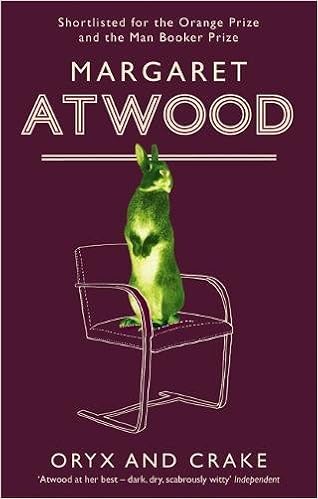
4) BlyssPluss in Margaret Atwood's Oryx and Crake (2003). Here's a working paper by Polina Levontin et al. about so-called "lone wolf" bioterrorism and apocalyptic science fiction.
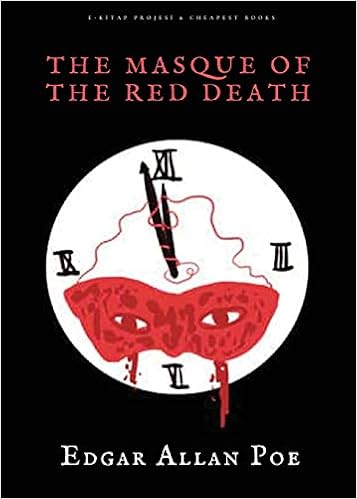
3) The Red Death in Edgar Allan Poe's 'The Masque of the Red Death.'
No pestilence had ever been so fatal, or so hideous. Blood was its Avatar and its seal—the redness and the horror of blood. There were sharp pains, and sudden dizziness, and then profuse bleeding at the pores, with dissolution. The scarlet stains upon the body and especially upon the face of the victim, were the pest ban which shut him out from the aid and from the sympathy of his fellow-men. And the whole seizure, progress and termination of the disease, were the incidents of half an hour.
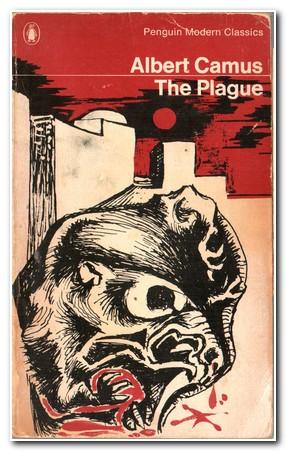
2) The eponymous plague of Albert Camus's existential novel The Plague.
Honorable mentions: Wuhan Flu documented by Eric Schaller, Download Syndrome documented by Steve Aylett, Jumping Monkworm documented by Sara Gwenllian Jones, and many, many more in Thackery T. Lambshead's Pocket Guide etc., the Plagues of Egypt in The Book of Exodus, the plague in Lucretius's On the Nature of Things, the pandemic in the game Pandemic, the plague in Plague Inc., Farmer's Tremors and billions of other procedurally generated Dungeons & Dragons diseases, the plague in Karen Lord's 'The Plague Doctors' (downloadable here), Andromeda in Michael Crichton's Andromeda Strain, the plague among livestock at Noricum in Virgil's Georgics (thanks Abi), children's voices in Ben Marcus's The Flame Alphabet (thanks Sam), the fast prion in Kim Stanley Robinson's Aurora, Captain Trips from Stephen King's The Stand (thanks everybody), the plague described in Boccacio's Decameron, the notional plague on both your houses in Shakespeare's Romeo and Juliet, the plague in Chaucer's 'Pardoner's Tale', the parasite in Octavia Butler's Clay's Ark, Georgia Flu in Emily St. John Mandel's Station Eleven, Snow Crash in Neal Stephenson's Snow Crash, Buscard's Murrain aka Wormwood in China Mieville's 'Entry Taken from a Medical Journal' (also in Thackery's), Diseasemaker's Croup in Neil Gaiman's Fragile Things (and Thackery's), the femicidal plague in James Tiptree Jnr's 'The Screwfly Solution', the consumption 'plague' in Frederik Pohl's 'The Midas Plague,' the plague in Sandra Newman's The Country of Ice-Cream Star, the bioweapon Clarity in Cory Doctorow's 'Chicken Little', the Motaba virus in the movie Outbreak, the fog in the movie The Fog, the 'ST-Demon' in the movie It Follows, the Simian Flu in the Planet of the Apes movies, the mass infertility in P.D. James's Children of Men, the Hopping Cough in The Smurfs, the atavism-causing Barclay's Protomorphosis Syndrome in an episode of Star Trek: The Next Generation and various other Trekkie plagues and contagions (Tribbles maybe?), the (mass but non-contagious) blindness in John Wyndeham's Day of the Triffids, the blindness in H.G. Wells's 'Country of the Blind', the blindness in José Saramago's The Blindness, the Wandering Sickness in H.G. Wells's Shape of Things to Come, the Monte Carlo viruses in Greg Egan's 'Blood Sisters', the devastating Golgafrinchan plague transmitted via unsanitized telephone in Douglas Adams's Restaurant at the End of the Universe, cholera in Gabriel Garcia Marquez's Love in the Time of Cholera, the plague in Anne McCaffrey's 'The Ship Who Mourned', smallpox etc. in Chelsea Quin Yarbro's Time of the Fourth Horseman, Dryditch Fever in Brian Jacques's Salamandastron, the Boston plague in Roger Zelazny's Damnation Alley, Amusica in Alaistar Reynolds's Century Rain, GuiltTrip in Peter Watts's Rifter books, Salt Plague in Kate Elliott's Spiritwalker books, Grayscale and Pale Mare and the Spring Sickness in G.R.R. Martin's Game of Thrones series, Spattergroit in the Harry Potter books by anonymous, the Forge in Robin Hobbes's Assassin's Apprentice and others in that series, Sevai and Vedet in Ursula K. Le Guin's Always Coming Home, the White Blindness (myxy) in Richard Adams's Watership Down, the noocytes in Greg Bear's Blood Music, the cult virus in Linda Nagata's Vast, and so on to ...
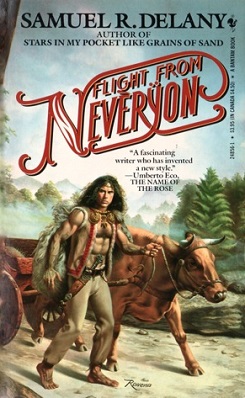
"Listen to me." The actor pulled him back. "Rights, you say? You're not going to get the plague. You know that as well as I do! Me and my kind, we're the ones in danger. And do you think for a minute if I thought there was any right, reason, or efficacy to be gained by tearing down this bridge, I wouldn't have been here days ago with a hammer myself? But that's for us to decide. Not you -" The actor paused, because, from the bandy-legged worker's eyes, two very fat tears, first as glimmerings along his lower lids, then as irregular spills in the torchlight, moved down his dark cheeks toward his beard.At one point Delany asks of characters of SFF, in what senses are their problems the same as his? And then: and in what senses are they different?
EDITS: Willis's Black Plague and Influenza double act added. Melding Plague added itself and incorporated Banks's HegSwarms.
Sunday, February 16, 2020
The New Voices of Science Fiction
This review originally appeared in Interzone 284 (Nov/Dec 2019).
The New Voices of Science Fiction
Ed. Hannu Rajaniemi and Jacob Weisman
Tachyon, 2019.
Science fiction is about, at least partly, the future. So here is a collection purporting to be about the future of science fiction: the future of the future. What does the future2 hold in store?
This is not a collection that sets out to discover anybody or give anybody their big break: this is an assembly of very accomplished stories, mostly published in the last five-ish years in major magazines like Asimov’s, Clarkesworld, Strange Horizons, and Tor.com, written by writers whom you may well have heard of or read, and may even have seen scoop up a Hugo or a Nebula Award. They ply their speculative art using a formidable albeit mostly familiar set of tools, plus some modest formal experiments. When a story does something formally striking, it generally has a clear justification closely related to its particular premise; for example, S. Qiouy Lu’s ‘Mother Tongues,’ in which neural interfacing can directly alter linguistic cognition, is very lightly macaronic: it’s almost all in English, but studded with bits of Mandarin and Cantonese dialogue. Across the anthology, far future is out, near future is in; distant planets and ETs are tired, some planet called Earth plus the alien-within-the-human are wired. None of the stories feel out of place, although a few of them could also easily blend into The New Voices of Fantasy or The New Voices of the Weird.
Two of this guy's favourites were by names new to me: Amman Sabet’s ‘Tender Loving Plastics’ and Samantha Mills’s ‘Strange Waters.’ Sabet’s Issa is a foster child raised by a robo-mom, who turns out just fine. Mills’s fisherwoman Mika is adrift on the seas of the centuries, desperate to get back to her children and afraid to check the history books to find out if she ever will. The theme of family threads through the anthology, although I felt like it was a theme that was used more often than explored. For example, the forms of non-monogamy that already exist in the real world are scarcely represented, let alone speculative reinventions or usurpations of the family. Maybe if you’re trying to cram all that rich character-driven narrative into only a few pages, the out-of-the-box resources of trad familial resonances are hard to resist?
Mills’s story exemplifies another big theme, time travel, appearing in six or seven stories. Why so much time travel, New Voices? Well, I felt like these time travel stories emerge more from the matrix of digital connectivity and self-fashioning -- that is, from the feeling of gazing at your Facebook photos from fifteen years ago, or searching for some deeply personal experience to find a forum of folks who share something similar -- than they do from Wellsian musings over future history, or from mindfuck “which-version-of-Baby-Hitler-will-killed-your-future-grandfather?!”-type hijinks. True, Alice Sola Kim’s ‘One Hour, Every Seven Years’ explores the chaoplexic ripples of a moment in time minutely variegated again and again. But in general the deep abiding questions are not so much, “Is causation necessarily linear?” “What dynamics shape social history?” and more things like, “Who am I?” “How literally should I take the term ‘self-care’?”
Nino Cipri’s ‘The Shape of My Name’ is exemplary here, with its interest in the intimate temporalities of an evolving subjectivity within one lifetime: in gender, in memory and identity, in hope and expectation, in personal nostalgia, in loss and grief, and in the changing horizons of who and how it is possible to be. In other words, this is partly a story about everything you wish you could tell your younger self. I liked it a lot, although I felt there was room for a richer exploration of the historically changing nature of masculinities and femininities, as well as the historically changing affordances for liberation, transformation, and subversion.
Amal El-Mohtar’s ‘Madeleine,’ which maybe isn’t strictly a time travel story, forms an interesting counterpoint. It’s a science fictional writing-through of Proust’s In Search of Lost Time, especially the famous episode in which the taste of a madeleine cake dipped in tea vivifies a long lost fragment of Marcel’s memory. ‘Madeleine’ is about Madeleine, and about the strange things that are happening to her: and so it half-invites us to imagine things from the cake’s perspective. Or at least, Madeleine’s reality is so fragile, so ready to crumble and dissolve, that we start to imagine what it might be like to lack your own story, to be merely a figment, trigger, or a cache of memories implicated in somebody else’s story. At the same time, Madeleine is clearly a privileged person (packed with cultural capital, for example: I love how she brandishes the maxims of continental philosophers as talismans to banish hexes). In its own discreet way, I think ‘Madeleine’ sets up subtle dialogue between Proustian preoccupations with memory gone privately astray, and questions of collective remembrance, questions of whose experience dominates history, and whose is marginalised or erased. Who gets to have their cake and remember it?
‘Madeleine’ is also part of a cluster of tales built on VR / simulation / out-of-body-experience conceits. ‘Utopia, LOLS’ by Jamie Wahls was very enjoyable -- a full unapologetic mash of late 2010s cutesy internetspeak and geek pop culture references with post-singularitarian ambiguous utopia in the vein of Banks’s Culture or Egan’s Permutation City. I bet some readers will find it cloying, but I was charmed. I admired Rebecca Roanhorse’s Hugo and Nebula Award-winning 'Welcome to Your Authentic Indian Experience™' for its elegantly constructed eeriness. As an exploration of cultural appropriation and the commodification of indigenous identities, however, it felt like it was often pretty broad brush. It could have been nice to dive into murkier and more conflicted aspects of these same themes?
On the cusp of 2020, we are allegedly in the early stages of a profound new wave of automation, occasioned in part by the rapid growth of machine learning AI, and the big data on which it feeds and flourishes. ‘Tender Loving Plastics’ addresses automation overtly; E. Lily Yu’s snappy and engaging ‘The Doing and Undoing of Jacob E. Mwangi’ does so indirectly, portraying a humane, post-work future in which the world self-divides into Doers (who actively participate in society) and Don’ts (who passively consume). Yu claps back a little at the knee-jerk veneration of hard work for its own sake, without totally dislodging that paradigm.
Other stories, perhaps, address automation allegorically. There is certainly a little cluster about being assimilated into something spooky and transcendent. Of these, Lettie Prell’s ‘The Need for Air,’ sticks closest to a techno-scientific register, exploring that tricksy transition to posthuman singularity, again through the lens of parenthood. Jason Sanford’s ‘Toppers’ and David Erik Nelson’s ‘In the Sharing Place’ both have a nice pulpy, slipstream-inflected vibe. Nelson’s reminded me a lot of Google’s convolutional neural network DeepDream, the one that spawns the trippy of oily-irridescent eyes swimming around in fractal puppies. The eye-mouths are calling: “What are you waiting for? Jump in!” What are you waiting for?
Sarah Pinsker’s marvellous ‘Our Lady of the Open Road’ is near-future punkpunk, which takes its sweet time and never feels slow, and is partly about the fear of being replaced by a hologram Bruce Springsteen (a Universal Fear). Luce and her band are on tour till they choke, in a US of A where there are precious few live gigs left. The nature of this technological displacement is interesting: the story assumes humans will still want humans making music -- even if we are content to have bands holographically beamed in by Amazon-esque content aggregator megaplatform StageHolo -- rather than imagining human bands being displaced by AI bands. Luce’s principled stance is emblematic of something larger, of course. Not only will Luce not sell out to StageHolo, she won’t even use a phone. Then again, Luce is no luddite: she just likes tech she can get her hands dirty with, tech that extends and empowers her, like her band kit and her van Daisy.
Still … as Luce doggedly crashed for the umpteenth time on a stranger’s slightly moist sofa, somewhere in the vicinity of a cat litter, I got to wondering. I got to wondering about automation anxiety itself as a species of Americana. The almost-lone refusenik is not the only way to represent resistance to the future decreed by Google et al., right? But I don’t believe there are any workers’ unions anywhere in New Voices. Much as I stan Luce, much as I see where she’s coming from, I’m not sure I like where she’s headed. Social and economic consequences of technological developments are never inevitable -- people matter, and the choices we make can change history -- and I feel like the story’s underlying idiom of ferocious resistance, resilience, and resourcefulness ultimately deserves better than Luce’s stoic rugged individualism, even if it comes with generous side-servings of friendship, community, and countercultural solidarity.
So I can heartily recommend The New Voices, although given how it helps itself to hype like “new kids” and “avant-garde,” I was a little wistful for a few more risks. Then again, what looks like a solid and safe strategy from the outside may well have felt fraught and conflicted from within. If the editors did feel they were taking risks, I’d be interested to know what those were? I guess if anything, some of these tales felt a bit too polished, almost as though they were ticking the boxes of what a really good piece of speculative short fiction should do. I’m looking at you, Sam J. Miller’s ‘Calved’: oh, you’re you’re going to deftly deploy ice imagery as you explore taciturn masculinities at the intersection of class, race, and sexuality, in a gritty climate change-centric near future, are you? Well, that really annoys me for some reason.
I was very grateful for the slow boil of Kelly Robson’s ‘A Study in Oils,’ the gung-ho chibi space opera japes of Suzanne Palmer’s ‘The Secret Life of Bots,’ the ‘here-is-a-robot-dinosaur’-ness of Darcie Little Badger’s ‘Robo-Liopleurodon!’, and the rough, ungainly energy of Vina Jie-Min Prasad’s ‘A Series of Steaks,’ which is very much “maybe the real getting blackmailed to 3D print boutique beef by a shadowy cartoonish villain ... was the friends we met along the way!”
The New Voices of Science Fiction
Ed. Hannu Rajaniemi and Jacob Weisman
Tachyon, 2019.
Science fiction is about, at least partly, the future. So here is a collection purporting to be about the future of science fiction: the future of the future. What does the future2 hold in store?
This is not a collection that sets out to discover anybody or give anybody their big break: this is an assembly of very accomplished stories, mostly published in the last five-ish years in major magazines like Asimov’s, Clarkesworld, Strange Horizons, and Tor.com, written by writers whom you may well have heard of or read, and may even have seen scoop up a Hugo or a Nebula Award. They ply their speculative art using a formidable albeit mostly familiar set of tools, plus some modest formal experiments. When a story does something formally striking, it generally has a clear justification closely related to its particular premise; for example, S. Qiouy Lu’s ‘Mother Tongues,’ in which neural interfacing can directly alter linguistic cognition, is very lightly macaronic: it’s almost all in English, but studded with bits of Mandarin and Cantonese dialogue. Across the anthology, far future is out, near future is in; distant planets and ETs are tired, some planet called Earth plus the alien-within-the-human are wired. None of the stories feel out of place, although a few of them could also easily blend into The New Voices of Fantasy or The New Voices of the Weird.
Two of this guy's favourites were by names new to me: Amman Sabet’s ‘Tender Loving Plastics’ and Samantha Mills’s ‘Strange Waters.’ Sabet’s Issa is a foster child raised by a robo-mom, who turns out just fine. Mills’s fisherwoman Mika is adrift on the seas of the centuries, desperate to get back to her children and afraid to check the history books to find out if she ever will. The theme of family threads through the anthology, although I felt like it was a theme that was used more often than explored. For example, the forms of non-monogamy that already exist in the real world are scarcely represented, let alone speculative reinventions or usurpations of the family. Maybe if you’re trying to cram all that rich character-driven narrative into only a few pages, the out-of-the-box resources of trad familial resonances are hard to resist?
Mills’s story exemplifies another big theme, time travel, appearing in six or seven stories. Why so much time travel, New Voices? Well, I felt like these time travel stories emerge more from the matrix of digital connectivity and self-fashioning -- that is, from the feeling of gazing at your Facebook photos from fifteen years ago, or searching for some deeply personal experience to find a forum of folks who share something similar -- than they do from Wellsian musings over future history, or from mindfuck “which-version-of-Baby-Hitler-will-killed-your-future-grandfather?!”-type hijinks. True, Alice Sola Kim’s ‘One Hour, Every Seven Years’ explores the chaoplexic ripples of a moment in time minutely variegated again and again. But in general the deep abiding questions are not so much, “Is causation necessarily linear?” “What dynamics shape social history?” and more things like, “Who am I?” “How literally should I take the term ‘self-care’?”
Nino Cipri’s ‘The Shape of My Name’ is exemplary here, with its interest in the intimate temporalities of an evolving subjectivity within one lifetime: in gender, in memory and identity, in hope and expectation, in personal nostalgia, in loss and grief, and in the changing horizons of who and how it is possible to be. In other words, this is partly a story about everything you wish you could tell your younger self. I liked it a lot, although I felt there was room for a richer exploration of the historically changing nature of masculinities and femininities, as well as the historically changing affordances for liberation, transformation, and subversion.
Amal El-Mohtar’s ‘Madeleine,’ which maybe isn’t strictly a time travel story, forms an interesting counterpoint. It’s a science fictional writing-through of Proust’s In Search of Lost Time, especially the famous episode in which the taste of a madeleine cake dipped in tea vivifies a long lost fragment of Marcel’s memory. ‘Madeleine’ is about Madeleine, and about the strange things that are happening to her: and so it half-invites us to imagine things from the cake’s perspective. Or at least, Madeleine’s reality is so fragile, so ready to crumble and dissolve, that we start to imagine what it might be like to lack your own story, to be merely a figment, trigger, or a cache of memories implicated in somebody else’s story. At the same time, Madeleine is clearly a privileged person (packed with cultural capital, for example: I love how she brandishes the maxims of continental philosophers as talismans to banish hexes). In its own discreet way, I think ‘Madeleine’ sets up subtle dialogue between Proustian preoccupations with memory gone privately astray, and questions of collective remembrance, questions of whose experience dominates history, and whose is marginalised or erased. Who gets to have their cake and remember it?
‘Madeleine’ is also part of a cluster of tales built on VR / simulation / out-of-body-experience conceits. ‘Utopia, LOLS’ by Jamie Wahls was very enjoyable -- a full unapologetic mash of late 2010s cutesy internetspeak and geek pop culture references with post-singularitarian ambiguous utopia in the vein of Banks’s Culture or Egan’s Permutation City. I bet some readers will find it cloying, but I was charmed. I admired Rebecca Roanhorse’s Hugo and Nebula Award-winning 'Welcome to Your Authentic Indian Experience™' for its elegantly constructed eeriness. As an exploration of cultural appropriation and the commodification of indigenous identities, however, it felt like it was often pretty broad brush. It could have been nice to dive into murkier and more conflicted aspects of these same themes?
On the cusp of 2020, we are allegedly in the early stages of a profound new wave of automation, occasioned in part by the rapid growth of machine learning AI, and the big data on which it feeds and flourishes. ‘Tender Loving Plastics’ addresses automation overtly; E. Lily Yu’s snappy and engaging ‘The Doing and Undoing of Jacob E. Mwangi’ does so indirectly, portraying a humane, post-work future in which the world self-divides into Doers (who actively participate in society) and Don’ts (who passively consume). Yu claps back a little at the knee-jerk veneration of hard work for its own sake, without totally dislodging that paradigm.
Other stories, perhaps, address automation allegorically. There is certainly a little cluster about being assimilated into something spooky and transcendent. Of these, Lettie Prell’s ‘The Need for Air,’ sticks closest to a techno-scientific register, exploring that tricksy transition to posthuman singularity, again through the lens of parenthood. Jason Sanford’s ‘Toppers’ and David Erik Nelson’s ‘In the Sharing Place’ both have a nice pulpy, slipstream-inflected vibe. Nelson’s reminded me a lot of Google’s convolutional neural network DeepDream, the one that spawns the trippy of oily-irridescent eyes swimming around in fractal puppies. The eye-mouths are calling: “What are you waiting for? Jump in!” What are you waiting for?
Sarah Pinsker’s marvellous ‘Our Lady of the Open Road’ is near-future punkpunk, which takes its sweet time and never feels slow, and is partly about the fear of being replaced by a hologram Bruce Springsteen (a Universal Fear). Luce and her band are on tour till they choke, in a US of A where there are precious few live gigs left. The nature of this technological displacement is interesting: the story assumes humans will still want humans making music -- even if we are content to have bands holographically beamed in by Amazon-esque content aggregator megaplatform StageHolo -- rather than imagining human bands being displaced by AI bands. Luce’s principled stance is emblematic of something larger, of course. Not only will Luce not sell out to StageHolo, she won’t even use a phone. Then again, Luce is no luddite: she just likes tech she can get her hands dirty with, tech that extends and empowers her, like her band kit and her van Daisy.
Still … as Luce doggedly crashed for the umpteenth time on a stranger’s slightly moist sofa, somewhere in the vicinity of a cat litter, I got to wondering. I got to wondering about automation anxiety itself as a species of Americana. The almost-lone refusenik is not the only way to represent resistance to the future decreed by Google et al., right? But I don’t believe there are any workers’ unions anywhere in New Voices. Much as I stan Luce, much as I see where she’s coming from, I’m not sure I like where she’s headed. Social and economic consequences of technological developments are never inevitable -- people matter, and the choices we make can change history -- and I feel like the story’s underlying idiom of ferocious resistance, resilience, and resourcefulness ultimately deserves better than Luce’s stoic rugged individualism, even if it comes with generous side-servings of friendship, community, and countercultural solidarity.
So I can heartily recommend The New Voices, although given how it helps itself to hype like “new kids” and “avant-garde,” I was a little wistful for a few more risks. Then again, what looks like a solid and safe strategy from the outside may well have felt fraught and conflicted from within. If the editors did feel they were taking risks, I’d be interested to know what those were? I guess if anything, some of these tales felt a bit too polished, almost as though they were ticking the boxes of what a really good piece of speculative short fiction should do. I’m looking at you, Sam J. Miller’s ‘Calved’: oh, you’re you’re going to deftly deploy ice imagery as you explore taciturn masculinities at the intersection of class, race, and sexuality, in a gritty climate change-centric near future, are you? Well, that really annoys me for some reason.
I was very grateful for the slow boil of Kelly Robson’s ‘A Study in Oils,’ the gung-ho chibi space opera japes of Suzanne Palmer’s ‘The Secret Life of Bots,’ the ‘here-is-a-robot-dinosaur’-ness of Darcie Little Badger’s ‘Robo-Liopleurodon!’, and the rough, ungainly energy of Vina Jie-Min Prasad’s ‘A Series of Steaks,’ which is very much “maybe the real getting blackmailed to 3D print boutique beef by a shadowy cartoonish villain ... was the friends we met along the way!”
Monday, February 10, 2020
BSFA Awards Shortlist 2019
... is out!
I like literary awards for loads of reasons, one of which is that they raise similar questions to AI and automation: Can you design and implement a procedure that will reliably replicate human judgment? You run the program again and again, and sometimes it appears to work, and sometimes it's a bit dodgy, and sometimes it's so dodgy you consider tweaking the code. (See note). In fact, it's probably time we had literary awards judged by AI. I will fully get on that.
Also, I like the way they are a democracy cosplay.
Also, I like the way they make so many people incredibly grouchy.
Including me. Comparing longlist with shortlist, I'm personally a little disappointed not to see Sandra Newman's The Heavens and Tim Maughan's Infinite Detail up for Best Novel. Zen Cho would have been great too.
Other minor kvetches? Well, no shade to the brilliant work of the shortlisted artists, it feels a slight shame that the BSFA Award for Best Artwork has once again effectively become the BSFA Award for Best Cover, after a just slightly more varied selection last year. I pledged 50 superdelegates to Cedric Mizero's A New Life in the Village exhibition and 50 superduperdelegates to SinJin Li Studios' Productive Futures conference ephemera (notably an insanely gorgeous booklet, but also name badges sporting symbols later revealed to assign each conference-goer to a science fictional profession and class status: this was a conference with worldbuilding), but no dice.
One of the nice and slightly precarious things about the BSFA Awards specifically is that they don't boundary-police too much, but despite technically allowing any genre fiction authored anywhere in the world -- there is no hard design rule, for example, that prevents the British Science Fiction Association Awards from being completed flooded one year by US-authored epic fantasy -- they do keep a focus on what you might roughly flail your arms at and designate "British SF." Still, in recent years Best Novel has included the likes of Yoon Ha Lee, Ann Leckie, Tricia Sullivan, Aliette de Bodard, and Nnedi Okorafor, and in Brexit year especially, it might have felt better to have a shortlist that wasn't so Very Very UK?
But like I say, these are nano-kvetches and overall -- looks like a seriously strong list! I've not read many of them or anything, but, you know, I Know the authors' Work. A bit of a mix of big publishers and smaller indie stuff is also a plus. I feel like BSFA Awards have a kind of Iowa and New Hampshire energy to them. Not bellweathers exactly, but at least an upward spurt of force that might propel something unusual into the swirling weather of the Nebulas and Hugos. Well done algorithm and the horde of human hearts that execute it.
The Non-Fiction category is a weird one, since it's so often comparing across different forms and modes. One big glitch: a piece I wrote for Big Echo, about Star Trek and work, slipped onto the Non-Fiction shortlist, among proper big books with squillions of hours of research and labour embedded in them.
Also maybe kind of interesting: the Shorter Fiction category is dominated by novellas. Why??? IS THE SHORT STORY DEAD???
Note: Except it's weird, because most of the circuitry this 'AI' is running on is actually made out of human judgments in the first place, only these are a different set of judgments from the set of judgments it's endeavouring to simulate. I.e. the judgment it is attempting to simulate is something like, "What is the best eligible book?" Whereas key judgments which actually operationalise the simulation include things like, "What system shall we use to tally up the votes? What stages shall we have? How shall we time things? Is this particular borderline work eligible in the first place?" And, "Shall I join the BSFA? Shall I vote? Shall I vote for this thing by my friend? Shall I vote for this thing I haven't read but which is by an author whose work I admire?" So related judgments, but different. Also, of course, not just judgments but also plenty of work, in particular the work of BSFA Award Administrator Clare Boothby.
I like literary awards for loads of reasons, one of which is that they raise similar questions to AI and automation: Can you design and implement a procedure that will reliably replicate human judgment? You run the program again and again, and sometimes it appears to work, and sometimes it's a bit dodgy, and sometimes it's so dodgy you consider tweaking the code. (See note). In fact, it's probably time we had literary awards judged by AI. I will fully get on that.
Also, I like the way they are a democracy cosplay.
Also, I like the way they make so many people incredibly grouchy.
Including me. Comparing longlist with shortlist, I'm personally a little disappointed not to see Sandra Newman's The Heavens and Tim Maughan's Infinite Detail up for Best Novel. Zen Cho would have been great too.
Other minor kvetches? Well, no shade to the brilliant work of the shortlisted artists, it feels a slight shame that the BSFA Award for Best Artwork has once again effectively become the BSFA Award for Best Cover, after a just slightly more varied selection last year. I pledged 50 superdelegates to Cedric Mizero's A New Life in the Village exhibition and 50 superduperdelegates to SinJin Li Studios' Productive Futures conference ephemera (notably an insanely gorgeous booklet, but also name badges sporting symbols later revealed to assign each conference-goer to a science fictional profession and class status: this was a conference with worldbuilding), but no dice.
One of the nice and slightly precarious things about the BSFA Awards specifically is that they don't boundary-police too much, but despite technically allowing any genre fiction authored anywhere in the world -- there is no hard design rule, for example, that prevents the British Science Fiction Association Awards from being completed flooded one year by US-authored epic fantasy -- they do keep a focus on what you might roughly flail your arms at and designate "British SF." Still, in recent years Best Novel has included the likes of Yoon Ha Lee, Ann Leckie, Tricia Sullivan, Aliette de Bodard, and Nnedi Okorafor, and in Brexit year especially, it might have felt better to have a shortlist that wasn't so Very Very UK?
But like I say, these are nano-kvetches and overall -- looks like a seriously strong list! I've not read many of them or anything, but, you know, I Know the authors' Work. A bit of a mix of big publishers and smaller indie stuff is also a plus. I feel like BSFA Awards have a kind of Iowa and New Hampshire energy to them. Not bellweathers exactly, but at least an upward spurt of force that might propel something unusual into the swirling weather of the Nebulas and Hugos. Well done algorithm and the horde of human hearts that execute it.
The Non-Fiction category is a weird one, since it's so often comparing across different forms and modes. One big glitch: a piece I wrote for Big Echo, about Star Trek and work, slipped onto the Non-Fiction shortlist, among proper big books with squillions of hours of research and labour embedded in them.
Also maybe kind of interesting: the Shorter Fiction category is dominated by novellas. Why??? IS THE SHORT STORY DEAD???
Note: Except it's weird, because most of the circuitry this 'AI' is running on is actually made out of human judgments in the first place, only these are a different set of judgments from the set of judgments it's endeavouring to simulate. I.e. the judgment it is attempting to simulate is something like, "What is the best eligible book?" Whereas key judgments which actually operationalise the simulation include things like, "What system shall we use to tally up the votes? What stages shall we have? How shall we time things? Is this particular borderline work eligible in the first place?" And, "Shall I join the BSFA? Shall I vote? Shall I vote for this thing by my friend? Shall I vote for this thing I haven't read but which is by an author whose work I admire?" So related judgments, but different. Also, of course, not just judgments but also plenty of work, in particular the work of BSFA Award Administrator Clare Boothby.
Tuesday, January 28, 2020
Night White Skies Podcast
Sean Lally and me discuss Strange Economics: Economic Speculative Fiction (ed. David Shultz) on Sean's Night White Skies podcast.
Wednesday, September 25, 2019
SFF and Psychology
I asked on Twitter for recommendations of SF writers interested in psychology, maybe with a slant toward hard sf (whatever that means). The thread still grows even though I have long since ceased feeding it heart. Here are some:
There is also Psychology: A Literary Introduction (ed. Laura Corlew and Charles Waugh).
An essay by Tansy Rayner Roberts on neurodiversity and mental health treatment in TV SFF.
Gavin Miller has an academic book on SF and pyschology in the works.
Alfred Bester (The Demolished Man)
Angela Carter (The Passion of New Eve)
Ann Leckie
Anne McCaffrey (Crystal Singers)
Anthony Burgess (A Clockwork Orange)
B.A. Chepaiti (Fear books)
Brian Aldiss (The Primal Urge)
C.R. Dudley
Chris Beckett
Connie Willis (Crosstalk)
Cory Doctorow (Walkaway, 'Chicken Little')
Diana Wynne Jones ('Carol Oneir's Hundredth Dream')
Doris Lessing (Canopus in Argos)
Edgar Allan Poe
Elizabeth Moon (Speed of Dark)
Emma Newman
George Orwell (Nineteen Eighty-Four)
Greg Bear (</Slant>)
Greg Egan
Greg Egan
Gregory Benford (The Stars in Shroud)
Ian Watson (The Embedding)
Isaac Asimov (Foundation)
Jack Vance (Languages of Pao)
James Tiptree Jnr
Karen Ripley (Slow World)
Kingsley Amis ('Something Strange')
Linda Nagata
Matthew de Abaitua (The Red Men, etc.)
Michael Crichton (The Terminal Man)
Michael Swanwick (Vacuum Flowers)
N.K. Jemisin (Broken Earth)
Nancy Kress (Beggars in Spain)
Nicola Griffiths (Cherryh's Cyteen, Ammonite)
Pat Cadigan (Mindplayers)
Pat Cadigan (Mindplayers)
Pat Murphy ('Rachel in Love')
Peter Watts (Blindsight, Into the Rift)
Philip K. Dick (The Alphane Moon, etc.)
Philip K. Dick (The Alphane Moon, etc.)
Raphael Carter ('Congenital Agenesis of Gender Ideation')
Samuel R. Delaney (Babel 17)
Theodore Sturgeon (More Than Human)
Ursula Le Guin (Left Hand of Darkness, Lathe of Heaven, etc.)
Vernor Vinge (A Deepness in the Sky)
Within the Wires podcast
Zenna Henderson ('The People')
There is also Psychology: A Literary Introduction (ed. Laura Corlew and Charles Waugh).
An essay by Tansy Rayner Roberts on neurodiversity and mental health treatment in TV SFF.
Gavin Miller has an academic book on SF and pyschology in the works.
Tuesday, September 17, 2019
Recent Stuff
Over at the Vector site, my brief note on last week's SFF conference in London, Productive Futures: The Political Economy of Science Fiction.
I have a novelette in Gross Ideas, an anthology about architecture and degrowth. The anthology includes Cory Doctorow, Camilla Grudova, Will Self, Mill & Jones, Joel Blackledge, Sophie Mackintosh, Steve Webb, Lesley Lokko, Rachel Armstrong, Lev Bratishenko, Torgeir Rebolledo Pedersen, Maria Smith, Robin Nicholson, Deepak Unnikrishnan, Edward Davey, and Jane Yeh. Edited by Edwina Attlee, Phineas Harper and Maria Smith, with design by Studio Christopher Victor.
We've just released the Call for Papers for the next themed issue of Vector, which will be about speculative fiction and art. Feel free to share, and get in touch with your ideas. If you're interested in writing for Vector in other capacities, also please do get in touch.
The latest issue of Vector, co-edited with Polina Levontin and Michelle Clarke, was all about African and Afrodiasporic SFF. If you'd like a copy, join the BSFA or get in touch with me. Some of the articles are on the Vector website.
WorldCon wasn't too long ago: here's a report.
And my essay 'Away Day: Star Trek and the Utopia of Merit' is in the latest issue of Big Echo. It's mostly about Manu Saadia's Trekonomics, and it thinks a bit about the role of gift economies in recent political SF and SF-influenced political theory. It takes issue with this:
One or two mini-reviews recently up on Goodreads.
The novel that I thought had found a home maybe hasn't after all. But hey.
Poetry stuff: Sad Press has just published Maria Sledmere's nature sounds without nature sounds. Poetry & Work: Essays on work in modern and contemporary Anglophone poetry, a collection I edited with Ed Luker, is in the final proofing stages and should be out by December.
I've also just written a fairly substantial draft of a series of essays dealing with the "marvellous moneys" stuff I've been working on over the past few years, i.e. money and value in SFF. If anyone wants a peek, let me know.
I have a novelette in Gross Ideas, an anthology about architecture and degrowth. The anthology includes Cory Doctorow, Camilla Grudova, Will Self, Mill & Jones, Joel Blackledge, Sophie Mackintosh, Steve Webb, Lesley Lokko, Rachel Armstrong, Lev Bratishenko, Torgeir Rebolledo Pedersen, Maria Smith, Robin Nicholson, Deepak Unnikrishnan, Edward Davey, and Jane Yeh. Edited by Edwina Attlee, Phineas Harper and Maria Smith, with design by Studio Christopher Victor.
We've just released the Call for Papers for the next themed issue of Vector, which will be about speculative fiction and art. Feel free to share, and get in touch with your ideas. If you're interested in writing for Vector in other capacities, also please do get in touch.
The latest issue of Vector, co-edited with Polina Levontin and Michelle Clarke, was all about African and Afrodiasporic SFF. If you'd like a copy, join the BSFA or get in touch with me. Some of the articles are on the Vector website.
WorldCon wasn't too long ago: here's a report.
And my essay 'Away Day: Star Trek and the Utopia of Merit' is in the latest issue of Big Echo. It's mostly about Manu Saadia's Trekonomics, and it thinks a bit about the role of gift economies in recent political SF and SF-influenced political theory. It takes issue with this:
Saadia’s Trekonomics, I think, invites Star Trek to join the satirical zeitgeist of Walkaway, If/Then, ‘Nose Dive’ et al. It offers the Federation as a society of abundance co-ordinated by egalitarian mechanisms of reciprocity. It recognises the close relationship between work and reputation in the Federation, and discerns immense informal social pressure to pursue status and success. At the same time, it supposes, forms or aspects of labour which traditionally have been difficult to automate – care work, emotional labour, creativity, teaching, “learning, making, and sharing” – take on enhanced significance in the Federation, softening this pressure. Pre-Fordist craft is offered as a point of comparison: “the organization of work in the Federation resembles older, preindustrial forms of arrangements.” Furthermore, “work in the Federation fulfills the deep human need for belonging and recognition. Work is another way to love and be loved and to express one’s unique sensibility.” Saadia’s Federation is certainly not primitivist! – its technology generates its abundance, and is instrumental in distributing it – but it is an attack on both contemporary capitalism and on the seductive nostrums of techno-meritocracy.I'm hoping to write a sequel eventually.
One or two mini-reviews recently up on Goodreads.
The novel that I thought had found a home maybe hasn't after all. But hey.
Poetry stuff: Sad Press has just published Maria Sledmere's nature sounds without nature sounds. Poetry & Work: Essays on work in modern and contemporary Anglophone poetry, a collection I edited with Ed Luker, is in the final proofing stages and should be out by December.
I've also just written a fairly substantial draft of a series of essays dealing with the "marvellous moneys" stuff I've been working on over the past few years, i.e. money and value in SFF. If anyone wants a peek, let me know.
Subscribe to:
Posts (Atom)